7 Mistakes You’re Making with Peptide Impurity Analysis (and How to Fix Them)

Molecular / analytical context (quick reference) Analyte class: synthetic peptides (variable sequence; variable MW)Common impurity classes: deletions, insertions, truncations, misincorporations, racemization/epimerization, deamidation, oxidation, adducts (TFA/acetate/salts), aggregates/oligomers, charge variantsPrimary analytical toolchain (typical): RP-HPLC/UPLC (C18/C8) + UV (214 nm) ± CAD/ELSD + (HR)LC–MS ± MS/MS; orthogonal: SEC, IEX/CEX, CE, peptide mapping(Plain-language note: impurity profiling is rarely “one…

Read More

Daily Peptide Research Spotlights: The Ultimate Guide to CJC-1295 NO DAC + Ipamorelin for Synergistic Results

Molecular Specifications and Technical Data The study of growth hormone secretagogues (GHS) has been significantly advanced by the synthesis of compound blends designed to mimic endogenous hormonal signaling. The combination of CJC-1295 NO DAC and Ipamorelin represents a dual-pathway approach to stimulating the pituitary gland. CJC-1295 NO DAC (Modified GRF 1-29) Molecular Formula: C152H252N44O42 Molecular…

Read More

7 Mistakes You’re Making with BPC 157 (and How to Fix Them in Your Lab)

Molecular Specifications Molecular Formula: C62H98N16O22 Molecular Weight: 1419.5 g/mol Sequence: Gly-Glu-Pro-Pro-Pro-Gly-Lys-Pro-Ala-Asp-Asp-Ala-Gly-Leu-Val CAS Number: 137525-51-0 Synonyms: Body Protection Compound 157, Bepecin, Gastric Pentadecapeptide Purity: ≥99% (HPLC verified) Format: Lyophilized powder Overview of BPC 157 in Peptide Research BPC 157 (Body Protection Compound 157) is a synthetic pentadecapeptide derived from a protective protein found in human gastric…

Read More

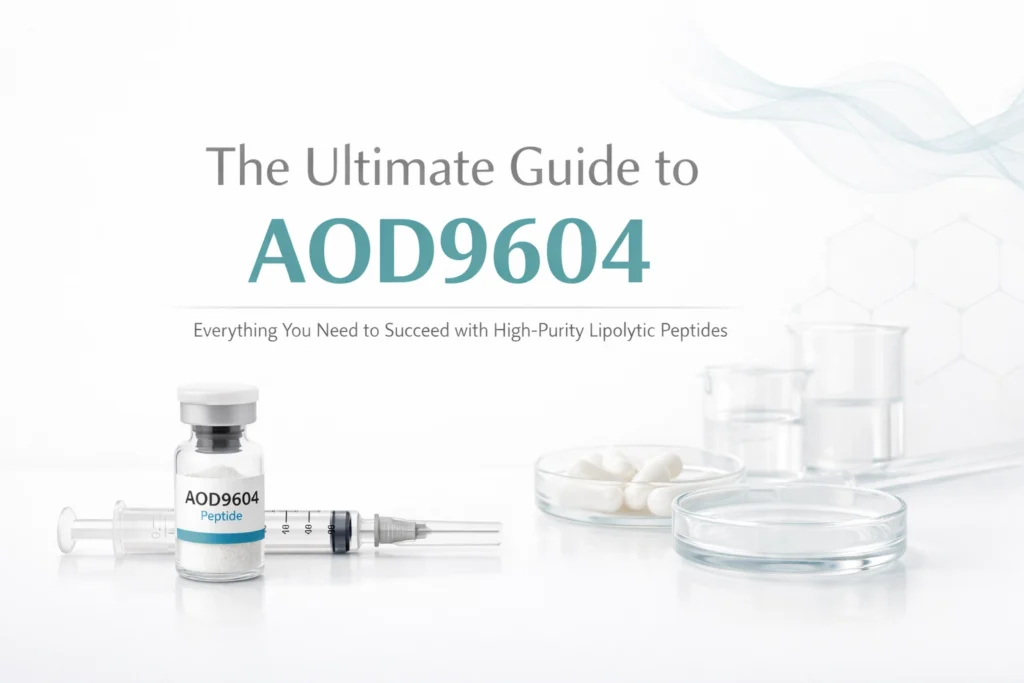
The Ultimate Guide to AOD9604: Everything You Need to Succeed with High-Purity Lipolytic Peptides

Technical Specifications Molecular Formula: C78H123N23O23S2 Molecular Weight: 1815.1 g/mol Sequence: Tyr-Leu-Arg-Ile-Val-Gln-Cys-Arg-Ser-Val-Glu-Gly-Ser-Cys-Gly-Phe CAS Number: 221231-10-3 PubChem CID: 16131447 Physical State: Lyophilized white powder Purity: >99% (HPLC verified) Solubility: Soluble in water or bacteriostatic water Overview of AOD9604 AOD9604 (Advanced Obesity Drug 9604) is a synthetic analog of the human growth hormone (hGH). Specifically, it is a…

Read More

NAD+: The Coenzyme Fueling Mitochondrial Research

Nicotinamide Adenine Dinucleotide (NAD+) is recognized as a fundamental pyridine nucleotide that functions as an essential coenzyme in all living cells. It serves as a critical electron carrier in redox reactions and acts as a substrate for various signaling enzymes. In the context of mitochondrial research, NAD+ is scrutinized for its role in maintaining cellular…

Read More

MOTS-c: Exploring the Mitochondrial-Derived Peptide in Metabolic Research

Molecular Specifications Sequence: MRWQEMGYIFYPRKLR Molecular Formula: C₁₀₁H₁₅₂N₂₈O₂₂S₂ Molecular Weight: 2174.6 g/mol CAS Number: 1627580-64-6 Purity: >98% (as determined by HPLC) Form: Lyophilized powder Classification: Mitochondrial-Derived Peptide (MDP) Overview of MOTS-c in Mitochondrial Research MOTS-c (Mitochondrial Open Reading Frame of the 12S rRNA-c) is a 16-amino acid peptide that represents a significant shift in the understanding…

Read More

The Next Frontier: GLP-3 Triple Agonists in Metabolic Research

GLP-3 triple agonists in metabolic research overview.

The evolution of metabolic research has witnessed a paradigm shift with the emergence of triple-agonist compounds, colloquially termed "GLP-3" in scientific communities. These next-generation research molecules represent a sophisticated departure from traditional mono-therapy approaches, simultaneously targeting three distinct receptor pathways: glucagon-like peptide-1 (GLP-1), glucose-dependent insulinotropic polypeptide (GIP), and glucagon (GCG) receptors. This multi-target activation strategy…

Read More

Epithalon: The Science of Telomere Protection and Longevity Research

Epithalon logo with scientific imagery emphasizing telomere research.

Molecular Formula: C₁₄H₂₂N₄O₉Molecular Weight: 390.35 g/molSequence: Ala-Glu-Asp-Gly Epithalon (also referenced as Epitalon) represents a synthetic tetrapeptide originally derived from bovine pineal gland extracts. This compound has been investigated extensively in cellular aging research for its capacity to activate telomerase: the enzyme responsible for maintaining and extending telomeres, the protective nucleotide sequences at chromosome ends that…

Read More

BPC-157: The Power of Body Protection Compound in Research

A vial labeled OPC-157 sits beside a petri dish and molecular models on a white surface.

BPC-157 (Body Protection Compound 157) represents a significant area of interest in regenerative research. This synthetic pentadecapeptide: a chain of 15 amino acids: is derived from a protective protein naturally occurring in human gastric juice. Over the past two decades, preclinical investigations have explored its potential role in tissue repair, inflammation modulation, and cellular protection…

Read More

Peptides: Why They’re Getting So Much Attention Today

Visualization of a molecular structure with interconnected atoms and bonds.

Peptides are showing up in more conversations than ever. People talk about them in wellness spaces, research labs, and even everyday forums. Their rise is not a trend. It comes from real interest in what they can support and how they fit into modern routines. Peptides are small by structure, yet they play a big…

Read More